
The e-invoicing requirement: How to make your company fit for the future
Digitalisation has long since found its way into all areas of our society, and accounting is no exception to this change. A key aspect of this development is the introduction of mandatory e-invoicing, which requires companies to switch to electronic invoicing. This measure is not only a step towards more efficient and sustainable business processes, but also a response to the increasing digitalisation of economic life.
Following the Federal Council's approval of the Growth Opportunities Act on 22 March 2024 and the obligation for your company to use e-invoicing from 1 January 2025, you are probably wondering what preparations you need to make and what impact this change will have on your company. In the following article, we will take a closer look at what exactly an e-invoice is and what advantages it offers, whether your company is subject to the obligation and how the tools from cloudworx for your Salesforce CRM can help you.
 X
X
What is an e-invoice?
An e-invoice, or electronic invoice, refers to an invoice that is issued, transmitted and received in a structured, electronic format. Unlike traditional paper invoices or simple PDF documents, an e-invoice enables automatic and electronic processing of invoice data. It contains all the necessary information in a pure semantic data format, which enables efficient processing and archiving, and complies with the European standard EN-16931 for electronic invoicing. The e-invoice is also based on an XML format, which allows invoice data to be imported directly into the processing systems without media discontinuity.
The following are not e-invoices, for example:
- Pure image files
- PDF files
- Scanned paper invoices
Although they are available electronically, these documents lack the proper data structure required for automated processing and further processing. If you would like to learn more about e-invoicing, I highly recommend the step-by-step guide to creating an e-invoice from our partner klippa.
What are the advantages of switching?
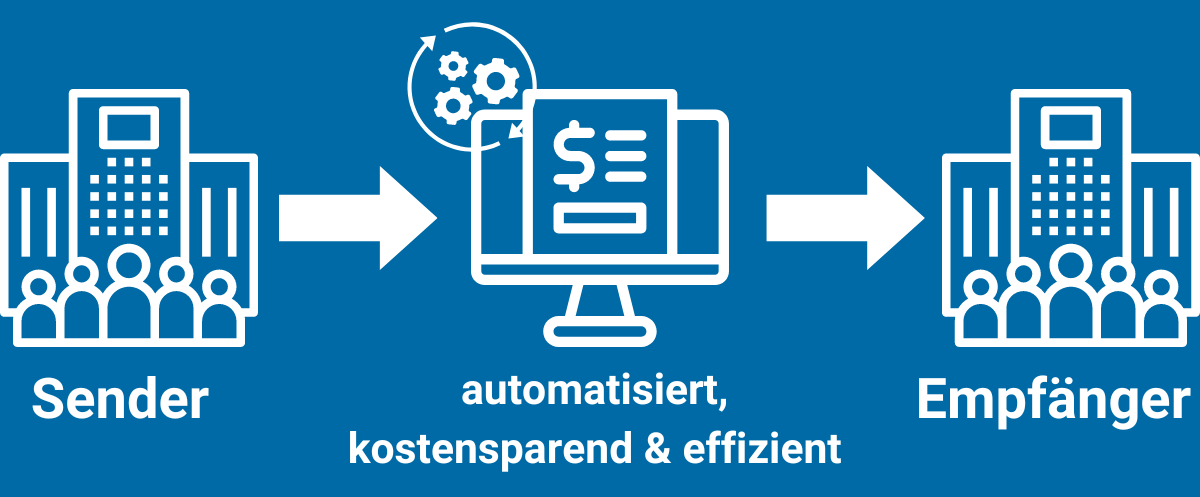
In an increasingly digital business world, e-invoices are becoming more and more popular, and for good reason. They offer a variety of benefits for both invoice senders and recipients, simplifying and optimising the entire invoicing process. Here, we list the advantages of e-invoicing for both your company and your customers in detail.
 X
X
Advantages for your company as a sender:
1. Simplified invoicing: The use of e-invoices significantly simplifies invoicing. Instead of laboriously printing, enveloping and sending paper invoices, e-invoices can be conveniently created and sent electronically from anywhere.
2. Shorter processing times: Switching to e-invoices results in shorter processing times in the invoicing process. Since the transmission is electronic, the typically long postal delivery times are eliminated and invoices reach your customers in less time.
3. Faster processing and more punctual payment: The automated processing of e-invoices means that invoices can be processed faster and payments made more punctually. This leads to improved cash flow for the invoice issuer.
4. Potential savings in invoice dispatch: The use of e-invoices enables your company to save on the considerable costs of paper and postage. This contributes to a more efficient use of resources.
5. Increased process quality: The automatic creation and validation of invoices minimises human errors by your employees, which leads to an increase in process quality. Compliance with standards and guidelines is made easier.
6. Flexible working: With e-invoices, your company as the invoice issuer can work from anywhere, as the entire process is digitised. This enables location-independent invoicing and increases flexibility for you and your employees who, for example, prefer to work from home.
Advantages for your company and your customers as recipients:
1. Optimisation of invoice processing: E-invoices make invoice processing much easier by quickly reading in invoice data. This saves time and significantly reduces the manual workload for your employees or your customers.
2. Increased data quality: The automated and correct processing of data from e-invoices improves quality, among other things by minimising typical human errors. This leads to fewer errors and greater accuracy of the information that is scanned and processed.
3. Potential savings in invoice processing: Automating and optimising the invoicing process with e-invoices enables your company to save on personnel costs in invoice processing, for example. This contributes to a more efficient use of your human and financial resources.
4. Enabling decentralised invoice processing: E-invoices can be received and processed from anywhere, enabling decentralised invoice processing. This improves the flexibility and agility of your company.
5. Flexible working: As for invoice issuers, the same applies to invoice recipients: the digitisation of the invoicing process enables flexible working from any location.
Overall, e-invoices offer a wide range of benefits for both you as an invoice issuer and as an invoice recipient, leading to a more efficient, cost-effective and flexible invoice processing workflow. By using digital technologies, your company can strengthen its competitiveness and prepare itself for the future.
Who is required to make the change?
Government institutions were initially required to switch to e-invoicing systems. This initially included federal ministries and constitutional institutions (since 11/18), followed by all other public contracting authorities (since 11/19) and then all invoice issuers to public authorities (since 11/20).
In addition, from 1 January 2025, the use of e-invoices will also be mandatory in business-to-business (B2B) transactions. This initiative, known as ‘VAT in the Digital Age’ (ViDA), is being promoted by the European Commission to combat VAT fraud. In Germany, the introduction of a mandatory e-invoicing system is firmly planned, but there are some transitional rules for the period until the end of 2027:
- Until the end of 2026: Paper invoices for B2B transactions will still be permitted; electronic invoices may differ, but require the recipient's consent
- By the end of 2027: Companies with total turnover of up to EUR 800,000 will have an extended transition period; for companies above EUR 800,000, other electronic formats will also be permitted, but only via electronic data interchange (EDI) and with the consent of the recipient
- From the beginning of 2028: New requirements for e-invoices become mandatory; use of established procedures such as EDI will then no longer be possible
What does this mean for your company?
1. Adaptation of business processes: Switching to e-invoices requires adapting your existing business processes and implementing new technologies and systems that can read, create, process and send them.
2. Compliance and legal certainty: By switching to e-invoicing in good time, you ensure that your company complies with the legal requirements of the Growth Opportunities Act and avoids possible penalties or sanctions by the state.
3. Costs and efficiency: On the one hand, the use of e-invoices enables cost savings by eliminating paper, printer ink and postage. On the other hand, e-invoices can automate and accelerate the entire invoicing process, resulting in more efficient accounting and faster payments.
4. Competitiveness: By switching to an e-invoicing system now, you are setting an example with your company and are prepared for the upcoming legal change. This can give your company a competitive advantage and strengthen your image as a modern and forward-looking company.
How can your company prepare?
1. Analyse your current processes: Start by analysing your existing invoicing processes and identifying any potential weaknesses or inefficient workflows. Ask yourself what you need for your business.
2. Select a suitable provider: Research different providers of e-invoicing solutions and choose the right system for you that meets your requirements and fits your budget.
3. Training and further education: Offer training and further education to ensure that your employees are familiar with the new systems and processes and can use them effectively.
How does cloudworx support your company during the transition?
Implementing an efficient system for managing and processing e-invoices requires a reliable platform that seamlessly integrates and automates all relevant processes. The tools from cloudworx for your Salesforce CRM can play a crucial role here by helping your company digitise and optimise its invoicing processes. Below are some of the ways in which the consultants and developers at cloudworx can help you switch to e-invoicing.
1. Automated invoice creation:
The tool developed by cloudworx, EasyFlow Invoices, now offers you the latest extension, which allows you to automatically generate invoices based on the data stored in your Salesforce CRM and send them using the out.bounz tool. By integrating accounting and billing systems, invoices can be created directly from Salesforce and sent to customers.
2. E-invoice portal for customers:
By setting up an e-invoicing portal in Salesforce, customers can receive, review and approve their invoices electronically. This simplifies communication with customers and enables faster payment processing. To this end, the cloudworx team has developed another tool for your company called millio, an efficient online banking solution directly integrated into Salesforce.
3. Automated invoice processing:
Salesforce can also be configured so that incoming e-invoices are automatically captured in.bounz tool, validated and imported into your Salesforce CRM. By starting workflows in in.bounz, records in your accounting and billing systems can be updated fully automatically and invoices forwarded to the appropriate departments or employees for further processing.
Conclusion
Switching to e-invoicing is not only a legal requirement, but also offers numerous advantages for your company, including cost savings, increased efficiency and improved competitiveness. By switching to an e-invoicing solution now and taking the right steps, you can ensure that your company is prepared for the future and benefits from the advantages of digitalisation.
Overall, cloudworx tools offer your Salesforce CRM a comprehensive platform for digitising and optimising invoice processes.
If you would like to find out how these tools for your Salesforce CRM can help you with the transition, our consultants and developers at cloudworx will guide your company every step of the way. Interested? Then click here and get in touch with us.